
Earworms
Issue no. 56

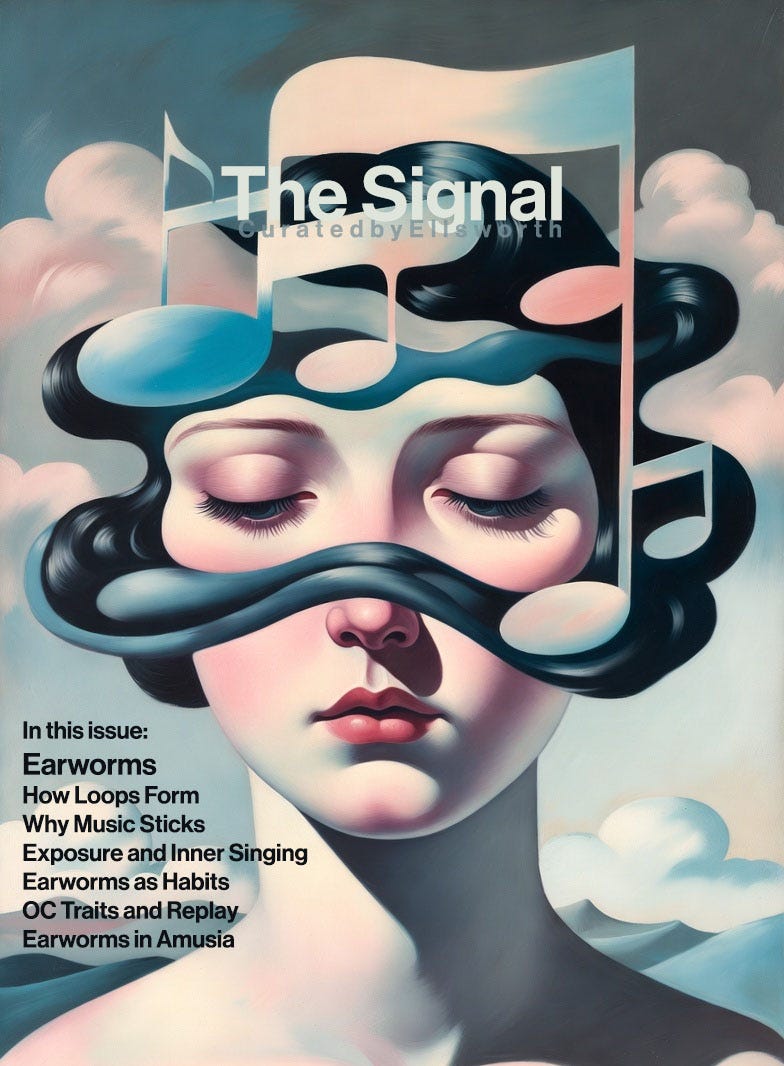
In honor of Britney Spears, who turns 44 today, we look at the science behind the earworm. Earworms, or involuntary musical imagery, are intrusive fragments of music that loop spontaneously in the mind, essentially functioning as a form of mental habit. But how, why!? They’re most frequently triggered by high exposure and familiarity to tunes containing contiguous, structurally repeated musical segments, and their onset is often associated with states of low environmental focus or cognitive idleness. Interestingly, the propensity for experiencing earworms is linked to the same regulatory pathways governing everyday habitual and compulsive behaviors, suggesting a shared neural mechanism. Further, the phenomenon persists even in individuals with congenital amusia (impaired musical memory, or the tone deaf), highlighting its foundation in involuntary auditory imagery rather than stable musical recall alone.
Why Some Loops Keep Repeating
Emery Schubert proposes that the brain encodes music as a chain of small segments. Songs that contain tightly repeated parts are more likely to produce loops during involuntary musical imagery. Low focus on the environment makes it easier for those stored segments to fire again.
https://doi.org/10.1177/20592043231165661
What Makes Music Stick in the First Place
Claire Arthur reviews why we still lack a complete explanation for why music becomes mentally sticky. She raises questions about what musical features make certain tunes latch on, what conditions trigger mental replay, and why music is especially good at generating involuntary loops compared to speech or other sounds.
https://doi.org/10.1177/20592043231164581
Exposure, Familiarity, and the Pull to Sing Along
Callula Killingly et al show that hearing a new song a few extra times makes it more likely to intrude the next day. Earworms draw on working memory and create a kind of silent inner singing that disrupts other thinking. Familiarity and the urge to sing along increased for all songs after repeated exposure.
https://doi.org/10.1177/17470218231152368
Earworms as Habits of the Mind
Chris M Dodds finds that people who fall easily into everyday habits also tend to have more frequent and harder to control earworms. The link holds even when anxiety is accounted for. Earworms were strongly tied to repetitive motor habits and repetitive mental behaviors.
https://doi.org/10.1016/j.concog.2025.103834
How Obsessive Compulsive Traits Shape Earworm Reporting
Callula Killingly et al compare long term self reports with moment to moment tracking. People higher in obsessive compulsive traits were less consistent across the two methods. The unpleasantness of the earworms stayed stable across measures. Traits influenced reporting but not how the episodes felt.
https://doi.org/10.1177/03057356241300425
Earworms in People with Amusia
Barbara Tillmann et al study congenital amusia, where musical memory is impaired but some musical processing is preserved. Almost all participants still experienced earworms, although amusics had them less often. Both groups reported familiar music with lyrics. Verbal earworms were more common in amusics, suggesting shared processes across types of auditory imagery.
https://doi.org/10.1177/20592043231166332