
Chile
Issue no. 58

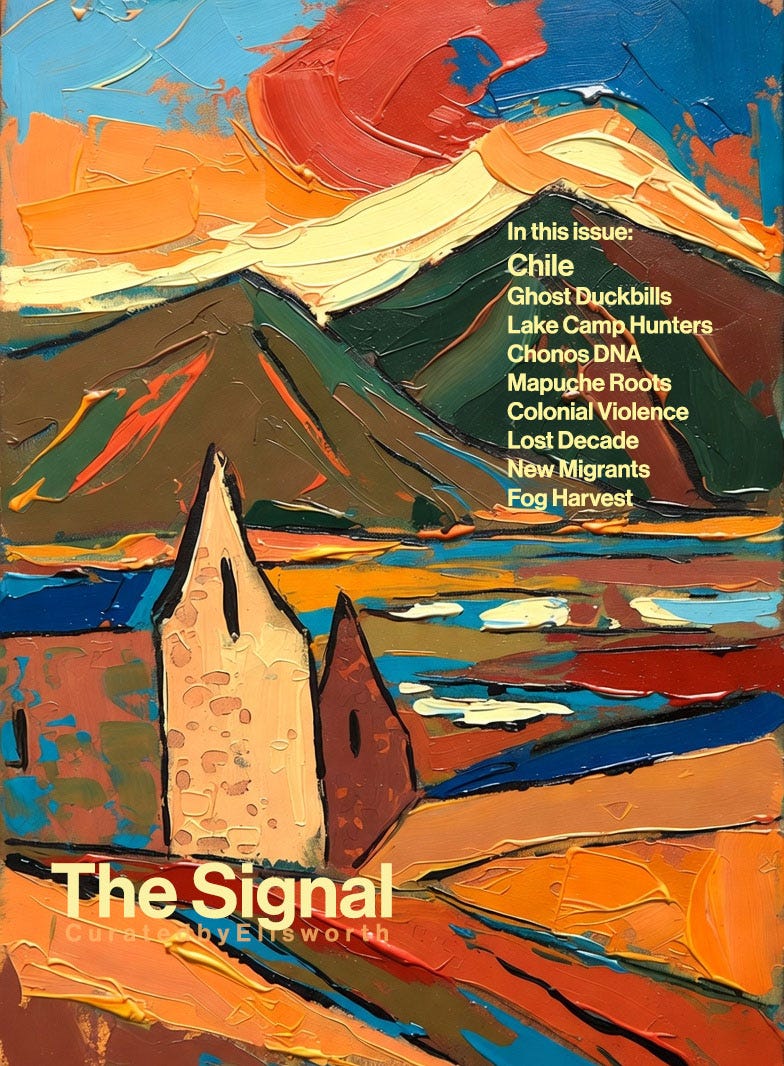
Chile is a country that is long and thin and seemingly full of past and present and as it turns out even some future. As such, scientists are doing things like confirming the final refuge of unique dinosaur lineages and excavating the 12,500-year-old camps of early hunters. New research traces the deep, regional roots of the Mapuche people and the inherited maritime knowledge that defined Chilean island life for centuries. Scholars document the brutality of colonial conquest through skeletal remains. Today, studies examine the nation’s domestic economic struggles and the social challenges accompanying a major new wave of migration. The landscape itself provides hope: new techniques are turning the desert’s fog into a sustainable source of fresh water.
Subantarctic Duck-Billed Dinosaurs
Jhonatan Alarcón-Muñoz et al describe Gonkoken nanoi, a duck-billed dinosaur that lived farther south than any hadrosaurids. A survivor of a different lineage, thriving where others never reached, Patagonia sheltered this hidden “ghost lineage” right until the asteroid hit.
https://doi.org/10.1126/sciadv.adg2456
Late Pleistocene Hunters at Taguatagua 3
Rafael Labarca et al study a temporary camp 12,500 years ago at an ancient lake. People hunted gomphotheres, prepared hides and bones, processed plants, and ground red ochre. The lake was a predictable stop on early mobility routes.
https://doi.org/10.1371/journal.pone.0302465
1,500 Years in the Chonos Archipelago
Roberta Davidson et al analyze ancient genomes from the Chonos islands. A distinct Patagonian ancestry emerges, split north–south, with northern links to Huilliche and Chiloé. Maritime knowledge was carried across generations.
https://doi.org/10.1101/2025.11.26.690513
Mapuche Origins in the Southern Cone
Epifanía Arango-Isaza et al trace the ancestry of three Mapuche groups. They share a Southern Cone core and split from Far South lineages thousands of years ago. Later, crops, words, and genes moved south from the Central Andes. Huilliche maintain extra links to the Far South.
https://doi.org/10.1016/j.cub.2023.05.013
Warfare and Colonial Violence
Juan Francisco Reyes Sánchez and Alberto Enrique Pérez uncover two victims of the War of Arauco. Their skeletons show torture and limb removal, with one burial even using a horse leg in place of the missing arm. The paper presents evidence of Spanish power reaching deep into Patagonia.
https://doi.org/10.1515/opar-2022-0307
Chile’s Lost Decade
Emiliano Toni et al show most of Chile’s slow growth since 2014 comes from internal policy shifts, not global market swings. Roughly two-thirds domestic, one-third external.
https://doi.org/10.1007/s11127-025-01318-w
Chile’s New Migrant Influx
María Belén Reinoso-Cataldo et al show that in the last decade Chile has become a major destination for migrants from Latin America and the Caribbean. Most movement is south–south. Young migrants face mental health challenges, and access to services varies. Reliable primary data is still limited.
https://doi.org/10.1016/j.jmh.2025.100363
Fog as a Water Source
Virginia Carter et al measure fog water in bone-dry Alto Hospicio. New nets on nearby ridges harvest up to 10 liters per square meter per day, enough to supply entire informal neighborhoods, water city parks, or grow fresh veggies in hydroponics. This renewable lifeline could be part of Chile’s water solution.
https://doi.org/10.3389/fenvs.2025.1537058b
Are there other countries that you have heard of? Let us know!