
Carnivorous Plants
Issue no. 55

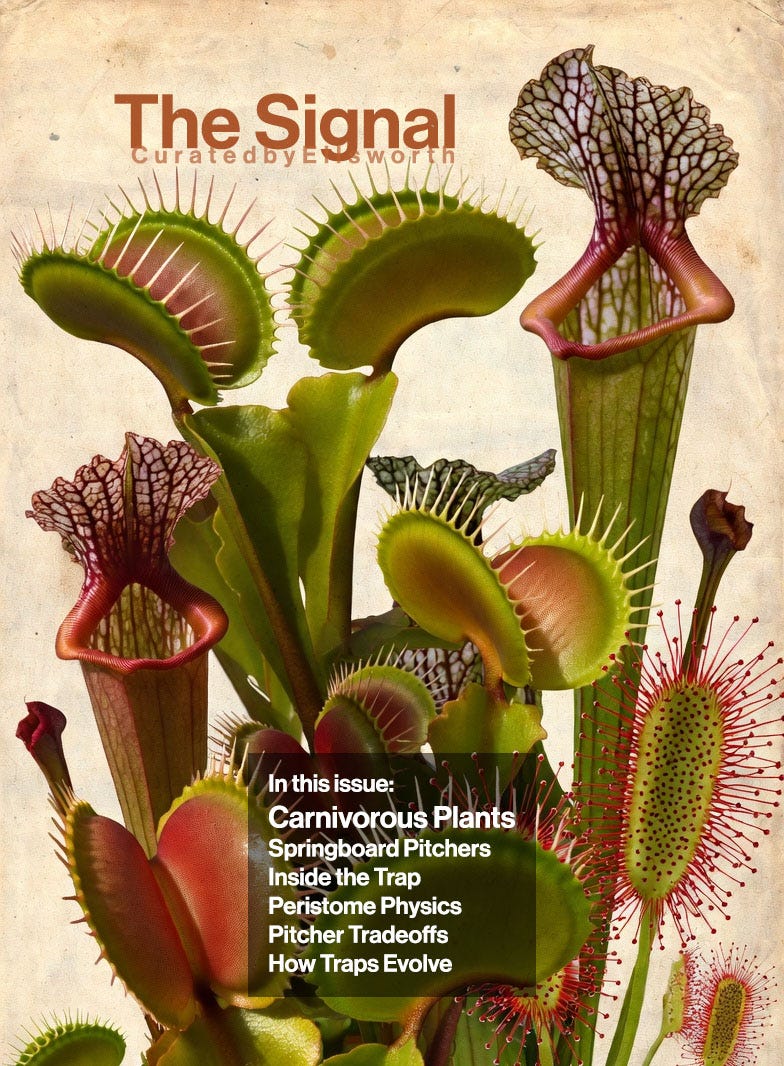
Carnivorous plants build traps that blur the line between leaf and machine. Here we look at pitcher geometry that turns raindrops into motion, digestive systems that work like botanical stomachs, peristomes shaped by physics, leaves managing the cost of carnivory, and the evolutionary paths that shaped diverse strategies for breaking down prey. It’s a little shop, little shop of knowledge.
Springboard Trapping in Pitcher Plants
Anne Kristin Lenz and Ulrike Bauer examine how N gracilis uses canopy-like lids that pivot when struck by raindrops. Micro-CT imaging reveals deformation zones that create a fast downward snap and a damped upward return. Geometry directs the anisotropic response that makes this extrinsically powered trap work.
https://doi.org/10.1098/rsbl.2022.0106
The Digestive Systems of Carnivorous Plants
Matthias Freund et al review how traps function as digestive organs. Specialized glands secrete mucilage, fluids, acids, and enzymes, then absorb released nutrients through transport proteins and endocytosis. Convergent evolution produced similar digestive capacities across plant lineages that modified leaves for prey capture.
https://doi.org/10.1093/plphys/kiac232
How Peristome Geometry Shapes Prey Capture
Derek E Moulton et al model Nepenthes traps using Newtonian mechanics. Flared rims, teeth, orientation, and size influence how insects slide into the pitcher. Physical tradeoffs reveal how different peristome forms may have evolved under shifting prey availability and size.
https://doi.org/10.1073/pnas.2306268120
Construction Costs and Tradeoffs in Pitcher Leaves
Kadeem J Gilbert et al examine the photosynthetic and structural costs of building three-dimensional pitcher leaves. Pitchers sit within a unique trait space defined by dual demands of nutrient capture and photosynthesis. The analysis outlines a pitcher leaf economics spectrum shaped by developmental, functional, and environmental constraints.
https://doi.org/10.1093/aob/mcaf024
How Diversity in Digestion Evolved
Andrej Pavlovič explores why digestive enzyme regulation varies across carnivorous plant lineages despite convergent use of similar proteins. Phylogeny shapes regulation more strongly than trap type or habitat. Caryophyllales use jasmonic acid to manage digestive activity, while other lineages rely on developmental, osmotic, or constitutive modes refined through paralog evolution.
https://doi.org/10.1111/nph.70229