
Asteroids
Issue no. 57

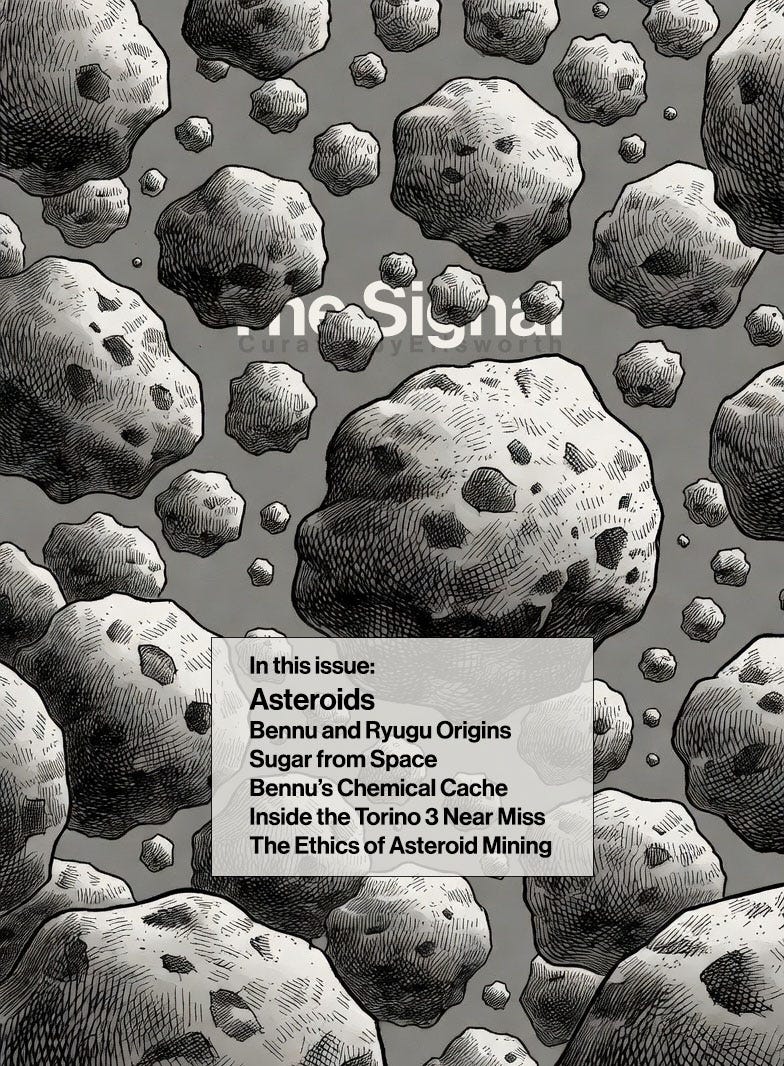
Asteroid samples are chemical diaries, every rock a potential confession of how the Solar System started and how the first ingredients for life arrived here on Earth. Recently, two asteroids, Bennu and Ryugu, have delivered pristine material untouched by Earth’s environment. Inside, researchers found sugars, amino acids, nucleobases, ammonia-rich organics, hydrated minerals, and carbonates that together sketch a picture of icy, water-altered parent worlds far from the Sun. A recent near miss from a fast-spinning near-Earth asteroid shows how physical characterization also feeds directly into planetary defense. And then there’s all those minerals, man. Who among you will mine them? All together, these studies show that carbon-rich asteroids may have supplied early Earth with the full starter kit for life while also reminding us why we track them so closely.
What Bennu and Ryugu Share Beneath the Surface
C Pilorget et al compare Bennu and Ryugu with near-IR microscopy and find strikingly similar mineral fingerprints. Both contain hydrated minerals, carbonates, ammonia-rich phases, and occasional anhydrous silicates inside a phyllosilicate-rich matrix. The similarities point to shared origins in the cold outer disk where Earth’s ingredients were shaped.
https://doi.org/10.1038/s41467-025-65438-z
Sugars That Life Needs, Found on a Small Asteroid
Yoshihiro Furukawa et al detect ribose, glucose, and other essential sugars in samples from Bennu. Their patterns match products formed when simple formaldehyde solutions react, pointing to sugary brines inside Bennu’s ancient parent body. This completes the trio of life’s core ingredients: nucleobases, amino acids, and sugars.
https://doi.org/10.1038/s41561-025-01838-6
Bennu Is Packed With Carbon, Nitrogen, and Ammonia
Daniel P Glavin et al show that Bennu samples are richer in carbon, nitrogen, and ammonia than most meteorites. They contain amino acids, amines, carboxylic acids, PAHs, and all five nucleobases found in DNA and RNA. Isotope ratios point to origins in very cold regions of the early Solar System.
https://doi.org/10.1038/s41550-024-02472-9
A Rare Torino Scale 3 Alert and a Fast-Spinning Near-Earth Asteroid
Maxime Devogèle et al report rapid observations of NEO 2024 YR4, the only asteroid ever classified as Torino Scale 3. Photometry and spectroscopy reveal a fast rotation period, Sq or K-type composition, and a shallow phase curve. The study shows how quick global coordination is vital for planetary defense.
https://arxiv.org/abs/2511.09405
When Mining Meets Space Law and Planetary Defense
Evie Kendal et al outline the technical, legal, and ethical challenges of asteroid mining. They discuss resource ownership, claim jumping, and the risk of weaponizing space. The work links asteroid dynamics to real-world decisions about extraction and global safety.
https://doi.org/10.3390/aerospace12060544